
7 technologies than can get you out of dialysis
⚫ Download the program to REVERSE KIDNEY DISEASE (special discount click here http://www.nhfkp.com/hope)
⚫ Subscribe to #00kidney https://www.youtube.com/subscription_center?add_user=00kidney
TRANSCRIPT
The world of kidney disease is on the verge of one of the greatest innovations of the century.
THIS will get you out of dialysis.
Katherine from 00kidney here, welcome to our journey together to a better kidney health.
There are 7 technologies that can get you – or a loved one – out of dialysis.
The days of dialysis and kidney transplants, as we know them, may be finally over.
Not many people know this, but when you get a kidney transplant, the surgeon will leave your original kidneys in place and just put the 3rd one in your pelvis.
Now, when I first learnt about this in school I was like “you’ve got to be kidney me!”
Ok guys, jokes aside, today we are really close to see some of the biggest medical breakthroughs ever.
In the near future, those with end stage renal disease may have several better options than dialysis.
Today, with my top 7 of the best and greatest ways to get out of dialysis, I’ll show you why.
7 bioartificial implantable kidney from UCSF
Ok, there’s an update regarding the artificial kidney development I want to show you today!
Now guys, today’s video is all about hope for the future, and the bioartificial kidney is one of my biggest hopes.
I’m not exaggerating.
For those of you that don’t know about the bioartificial kidney from UCSF, we are talking about a lab made kidney that can be implanted and that will be able to do the job of the kidneys completely.
It won’t need any external power and it’s meant to be permanent, without the need for immunosuppressant drugs.
Now some good news:
According to their Facebook page, the kidney project team finally restarted working on the artificial kidney at 100% capacity!
There’s a big chance they will actually be able to START TO TEST the bioartificial kidney on HUMANS already in 2022 as predicted by Dr Shuvo Roy, project leader, in a recent interview.
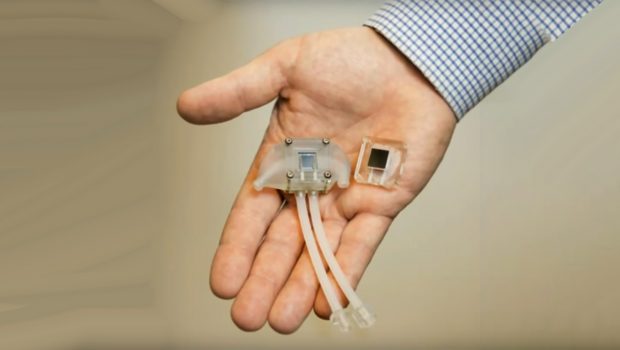
In fact, these you can see here are already images of the final product.
The bioartificial kidney consists of two modules that work together and that are powered by the human body.
Now, one of these two parts, is the hemofilter.
It basically does what a dialysis machine does. It removes toxins and scores from the blood.
They have already tested it on animals and proven that it works.
There’s a second component in the bioartificial kidney, the bioreactor, which helps performing the other functions of the kidney, such as regulating blood pressure.
Now, this part too was tested on animals successfully – as we can see here.
So, why isn’t this ready yet?
We want it now!
Here’s what Dr. Shuvo Roy , in a recent interview, project leader says about this
What we are doing right now is working on the integration of these two components and on obtaining the FDA approval for testing the completed bioartificial kidney on humans.
“We expect to arrive at this final stage of clinical trials by late 2021.”
Very interesting, he also added that he is confident that the completed product will be commercialized already in 2025!
Amazing! I told you we are on the verge of some incredible innovation! And this is just our number 7 for today!
And by the way, if any of you guys are interested in participating in the human trials for the artificial kidneys that could be starting already next year, The Kidney Project has a database, a sort of waiting list for people wanting to be test subjects for the artificial kidney – you can find all the info down in video description.
Even better, a part of this incredible device will be ready to help people on dialysis much sooner than that.
It’s our number 6 for today!
6 iHemo
iHemo is a needle-free system for implanted dialysis being developed based on the bioartificial kidney’s hemofilter.
As we have seen, the bioartificial kidney is made from 2 components.
They both work already, what’s missing is integration.
So the researchers thought that connecting one of these two components – the hemofilter – to a portable dialysis machine could be a great way to make home dialysis better.
Ok, ok, I know what this looks like.
They are just finding a way to market an incomplete device.
BUT it’s not like that.
Let me explain.
When you start dialysis, you have 2 choices. Peritoneal or hemodialysis.
Hemodialysis is more effective, and it needs to be done 3 times a week for 4 hours usually.
But you have to do it in a clinic.
Peritoneal can be done at home, but it needs to be done every night for 9 hours.
iHemo, on the other hand, uses the implantable bioartificial kidney’s blood filter (Hemofilter) to perform hemodialysis at home without any of the risks and limitations involved with peritoneal dialysis.
iHemo will simplify dialysis and reduce its risks by creating permanent connections between the patient’s blood vessels and the Hemofilter, eliminating the need for needles and keeping all blood processing within the body, with only dialysate cycling in and out.
Also, it’s a “stepping stone” on the way to the bioartificial kidney.
So it’s a great innovation, in my opinion.
Now something completely different
Number 5 activated charcoal
Today’s video is not just about technologies, we will also see a couple of home remedies that are already changing the lives of people with kidney problems.
In particular, thanks to activated charcoal, doctors were able to give their patients even years free from dialysis, with a good quality of life as well.
Activated charcoal is really popular as a detoxifier.
People use it every day in small dosages as a home remedy against bloating, gas, diarrhea and … also to get their teeth whiter.
Emergency room doctors, on the other hand, use it to treat overdoses and poisoning.
All this is possible because activated charcoal is extremely good at binding to toxins in the digestive system and removing them.
This is why it has been used with success as a part of a clinical trial on stage 5 ckd patients.
It so good that there’s a study conducted on 9 stage-5-patients who refused to start dialysis and decided to use this remedy instead.
They were treated with activated charcoal and nondialytic care for 10 months.
The results are shocking.
In the study, patients with kidney disease stage 5 were administered 30 grams of Activated charcoal per day.
Basically, this treatment was able not just to prolong the life of their kidneys, but to improve their function.
The treatment was so effective that all of them had a significant decrease in blood urea and creatinine levels.
Ok, the reason why I’m comparing activated charcoal to innovations such as the artificial kidney, is because this detoxifier is already saving people from dialysis.
A special type of activated charcoal – kremezin – is actually being prescribed to kidney disease patients in stage 3 and 4 in the Philippines, Japan, Taiwan and South Korea.
Researchers from South Korea, in particular, believe that taking kremezin can delay dialysis up to 4 years in stage 4 kidney disease patients.
And what I think is that this kind of innovations is what people need right now.
Now guys, the reason why these innovations are bound to change the lives of kidney disease patients sooner than we think is because dialysis is an outdated way of dealing with CKD.
Dialysis as a treatment needs to be replaced soon.
It was first used as a treatment for kidney failure in 1943.
The first kidney transplant was performed in 1962.
We, in 2021, are no more satisfied with having just these two options – one from the 40s and one from the 60s – for a disease that kills more people than any virus out there.
More than 1 in 7 adults in the U.S. has kidney disease – according to a recent statistic – but 90% of them don’t know they have it yet.
This is why people need to know.
We need more awareness about these new developments.
So please share this video now with anyone you know who is… an adult.
Share this now to raise the awareness.
Number 4 Paired organ exchange program
When people end up on dialysis, the first thing their loved ones think is: will I be able to give them a kidney?
Unfortunately, very often compatibility issues prevent this.
Not anymore.
The paired organ exchange program is a program that’s being run by the Alliance for Paired Donation and the National Kidney Registry with just one goal in mind:
Helping people in need of a kidney to FIND one.
Because being able to receive a kidney from a living donor is the best chance for someone with kidney failure.
Unfortunately, the organ shortage is becoming more severe every year and it’s not a secret that the kidney is the organ most needed.
Just in the U.S., more than 90,000 patients are waiting for kidney transplants, yet only about 20,000 transplants are performed each year.
Annually, nearly 5,000 people on the transplant waiting list die without getting a transplant.
The Paired organ exchange program can help.
Let’s say that you need a kidney and you’re so lucky that a relative is willing to donate you one of theirs.
There’s no guarantee that they will be able to do so.
Kidney donors must have a compatible blood type and tissue type with the recipient.
Even siblings only have a 25% chance of being an “exact match” for a living donor.
To overcome this problem, an increasing number of kidney donors and recipients are turning to paired kidney exchange.
In a paired exchange, an incompatible donor/ recipient pair (such as a husband and wife that don’t have compatible blood types) are matched with another incompatible donor/recipient pair for a “swap”.
Each donor gives a kidney to the other person’s intended recipient.
This could be done with four people, six people or sometimes even more.
This way, receiver can find a perfect match as a donor.
Those who get one from a perfectly matched donor, can expect over 35 years from their transplanted kidney.
Now, what should you do if you are interested in a paired exchange program?
Contact your transplant hospital or a transplant hospital that has an exchange program.
I’ve put a link in description to the complete list of hospitals in the US hosting these programs.
And, what to do if you don’t have anyone who can donate you a kidney?
Well, some people resort to buying one.
This has some downsides, though.
3) LEGAL ORGAN MARKET
While in almost any part of the world it is illegal to buy or sell organs, Iran has a legal market for organ donors.
The government in Iran offers people a legal way to buy and sell kidneys.
They even have a fixed price for a kidney – $4,600.
Looks like a bargain, doesn’t it?
In the U.S. the average dialysis patient costs almost 90.000$ per year in treatment.
In Iran, it’s different.
Today, if you walk the streets in Tehran, you would read dozens of messages, accompanied by phone numbers and blood types of people selling their kidney.
Since 1993, doctors in Iran have performed more than 30,000 kidney transplants this way.
While this could look like a beacon of hope for someone in dialysis, this system hasn’t always worked as it’s supposed to.
Because many people in Iran still live in poverty.
It’s very easy to fall prey of scams and merciless dealers when you’re poor.
Because not all the sales of organs are regulated by the government.
Hundreds of people are believed to have sold kidneys and other organs through shady dealers in the past few years.
The illicit trade is largely lucrative for dealers.
some news reported of people who were FORCED TO “DONATE” ORGANS against their will.
And we need to consider the personal, physical, and financial consequences for vendors themselves.
They’re not supported by the medical system and are often left by themselves when it comes to follow up cares.
Not to mention that foreigners are barred from the national Iranian organ market program.
So, don’t go forging paperwork to enter Iran illegally now, that’s not a good idea.
The daily number of human trafficking crimes in the middle east is frightening.
It’s not something I want to encourage.
On the other hand, something absolutely worth encouraging is the research on
Number 2
The 3d printed kidney.
METTI SLIDE
3d printed organs are already a reality,
What you see here is the first full size, completely 3d printed human heart!
Amazing, isn’t it?
It was created by researchers at the Carnegie Mellon University.
So yes, they already have printed a full sized human heart and they are also using this technology for skin and bone repair.
But, you know, they should have started from a kidney, in my opinion.
More people have kidney disease than heart disease.
The kidney is by far the most needed organ for transplant.
And while a 3d printed kidney is still in its… embryonic phase there’s a reason why I think 3d printed organs are going to be even more relevant than the bioartificial kidney.
The reason is a big breakthrough in the world of 3d printed organs.
It’s called bioink and it’s something that could actually lead to the creation of the first 3d printed kidney.
This is what researchers from the award-winning Lewis Lab at Harvard University are hoping.
They are developing a 3d printed kidney made from stem cells AND modelled using a special liquid material known as bioink.
Which is an incredible innovation.
This is actually the most advanced project in the field of regenerative medicine and could change the lives of millions of people around the world.
Researchers from The State University of New York at Buffalo have now found a way to create vascularized organs with a 3d printer.
The aim here would be creating a 3d printed kidney using only the stem cells from the body of the receiver of the kidney.
This would mean no risk rejection, no risk of incompatibility and no immunosuppressant drugs.
Now, if you think this is science fiction, please take a look at THIS interview
Our number 1 is the wearable kidney.
And he was the first man on earth to use a wearable kidney instead of dialysis.
What’s more, he was wearing a 2.0 version of the wearable kidney, while they are now testing a 3.0 version of the device.
Which is going to be much lighter and smaller than the version we have seen – 2 pounds versus 11 pounds.
According to Dr. Gura, the inventor of the wearable kidney, or wak
“The WAK will disrupt the dialysis industry and reduce the staggering costs of treating ESKD patients.
Most patients today depend on dialysis clinics to receive their care, but application of the WAK instead will make this unnecessary.”
Cant’ wait for this one to be available!
And if you want to know more about the WAK, please watch this video now.
Ok guys, this was our last one for today.
A new video is coming next Tuesday – I hope to see you there.
In the meantime, keep taking good care of your kidneys and be good to yourself.
This is all for today, thank you for watching!
About the Author

Michaelw Hi, my name is Michael and in this blog I'm gonna share the story of how I got off kidney dialysis for good. Getting off dialysis isn't easy at all, and that's why I'm trying to help people as much as I can.
Related Posts

5 mineral hacks that can make all the difference with CKD →

Stop Taking These Kidney Damaging Supplements Now! →

This herbal remedy can lower creatinine by 10.3% in stage 5 →


